Publication
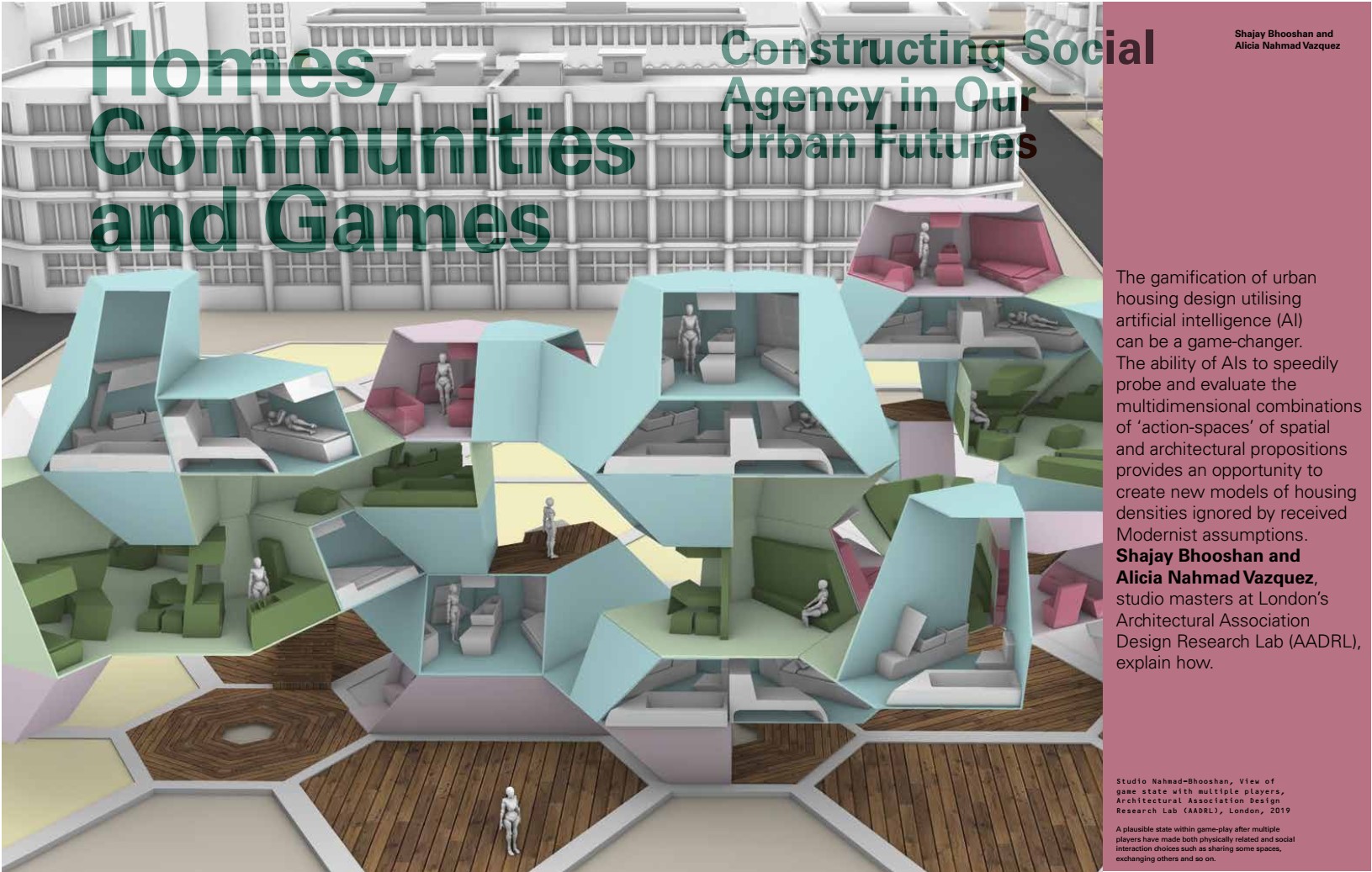
Homes, communities and games: constructing social agency in our urban futures
2020
Housing, Gamification, Social agency
View publicationAbstract
In December of 2017, Deepmind’s AlphaZero taught itself to play chess by playing 44 million games against itself at the rate of 1,000 games a second. It promptly proceeded to demolish the current world champion chess-playing software Stockfish. It was later understood that Alphazero had discovered and built upon previously abandoned human strategies of play in order to deal with its computing resource limitations in comparison to its opponent.1The future of housing and urban design can be viewed through the lens of this profound technological event – a perspective that provides an operational plan to pry the built environment away from the near-ubiquitous, century-long dominance of Le Corbusier’s ideas of Maison Dom-Ino (1915), Unité d'Habitation (1947) and its urban cousins – the Plan Voisin (1925) and Ville Radieuse (1930). The predominant reason for the prolonged and widespread success of Maison Dom-Ino-based housing and Ville Radieuseinspired city plans is their amenability to automation through standardisation and, consequently, their ability to fill the ever-present need for rapidly deployed, mass-repeated ‘affordable’ housing and expansionist models of urbanisation.2 Alternatively, there is the necessary, sustainable and vibrant model of compact urban infill and intensification with digitally empowered entrepreneurs – consumers, architects, developers, contractors and tradespeople. This involves far greater variables and thus is a worthy fit for digital design and fabrication technologies that are increasingly competitive on the automation and cost front while providing a superior ability to satisfy complex, multivariable goals and trade-offs in possibly every other physical and social dimension. The greater degrees of freedom they afford enables looking at the models of housing and urbanism that Modernism overlooked. In our search for solutions to address the opportunities and needs of our urban futures, we are now capable of, and should start looking beyond Modernism’s singular focus on standardisation.
Citation
Bhooshan, S. and Vazquez, A.N., 2020. Homes, communities and games: constructing social agency in our urban futures. Architectural Design, 90(3), pp.60-65.