Publication
Particle-spring systems: Design of a cantilevering concrete canopy
2014
Computational Formfinding, Particle Spring systems
View publicationAbstract
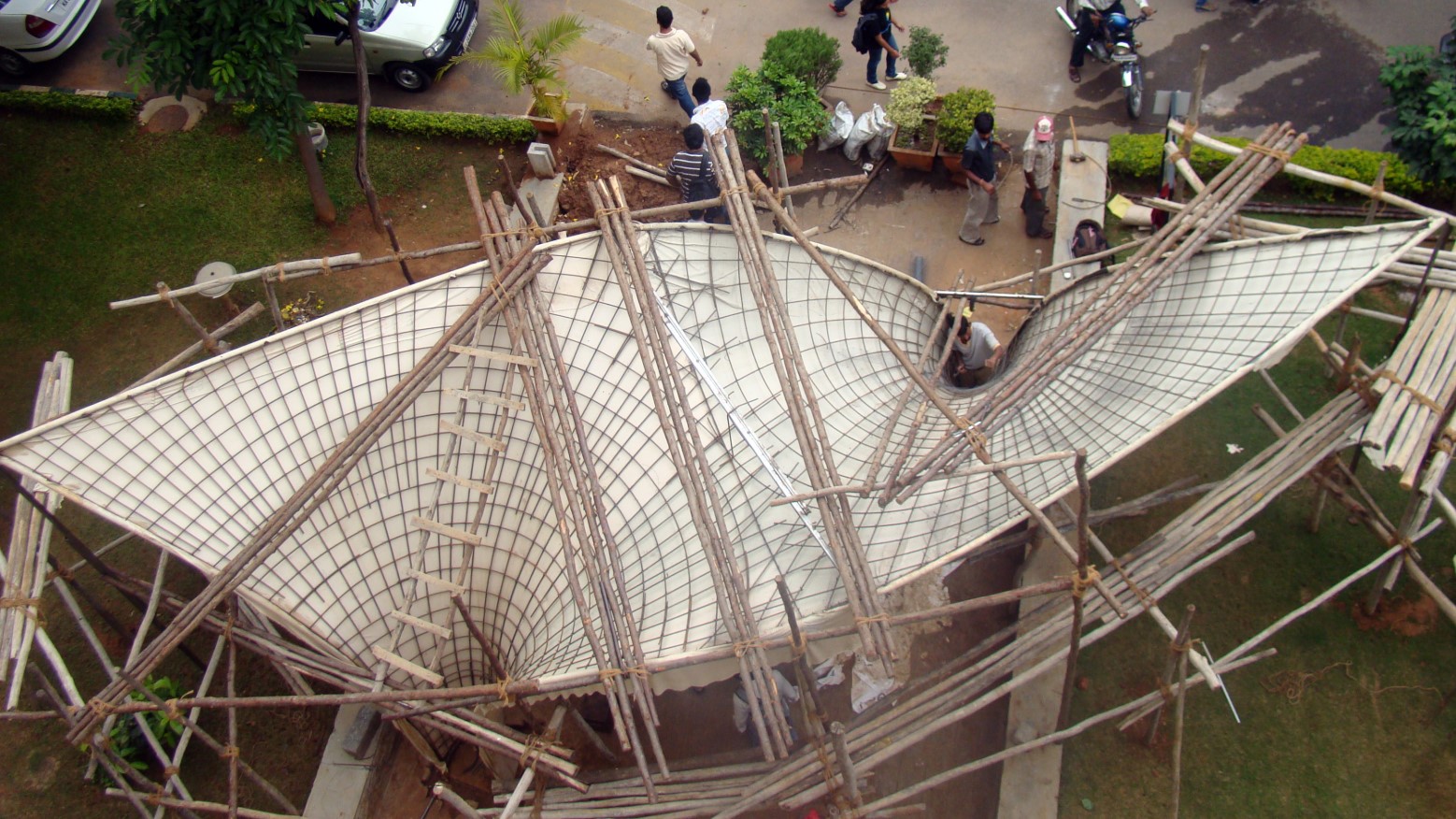
Physical form finding using hanging chains and associated architectural design methods, as exploited by Antoni Gaudí, Heinz Isler, Frei Otto and others, are very well-established tools for the shape generation of form-active and form-passive structures, appreciated by architects and engineers alike (see Chapter 4). Their digital simulation using particlespring simulation frameworks is also fairly established in practice following the work of early (architectural) exponents, Kilian and Ochsendorf (2005). Design methods employed in architectural practice for the formal and spatial development of geometry rely on iterative processes carried out within a relatively short timespan. Both properties are found in ParticleSpring (PS) systems, making them ideally suited to architectural design. Indeed, many algorithms and digital tools for form finding in architecture use a particle-spring framework to simulate hanging or pretensioned chains and grids. The workflow presented here responds to the ambitions and complexities of scale, time constraints and delivery mechanisms of contemporary architectural and engineering practices. A simulation-based workflow is presented that provides intuitive control for the designer and that incorporates constraints of the production process. This approach adopts subdivision surfaces for parameterization and particle-spring systems for form finding. It resolves the dichotomy between lower resolution CAD geometry used for design and modelling and higher resolution geometries used for subsequent simulation and analysis. First, we discuss how the definition of low-resolution initial conditions are refined using subdivision surfaces, offering the designer better control of the topology. Second, the resulting mesh is then used for the particle-spring form finding. A comprehensive mathematical description of particlespring systems for structural design is given, including the use of explicit and implicit integration to solve for static equilibrium. Finally, we offer some details about subsequent fabrication and construction.
Citation
Bhooshan, S., Veenendaal, D. and Block, P., 2014. Particle-spring systems. London: Routledge, Taylor & Francis Group.