Publication
Use of Sub-division Surfaces in Architectural Form-Finding and Procedural Modelling
2011
Physically based simulations, form finding, procedural architectural modelling, and subdivision surfaces
View publicationAbstract
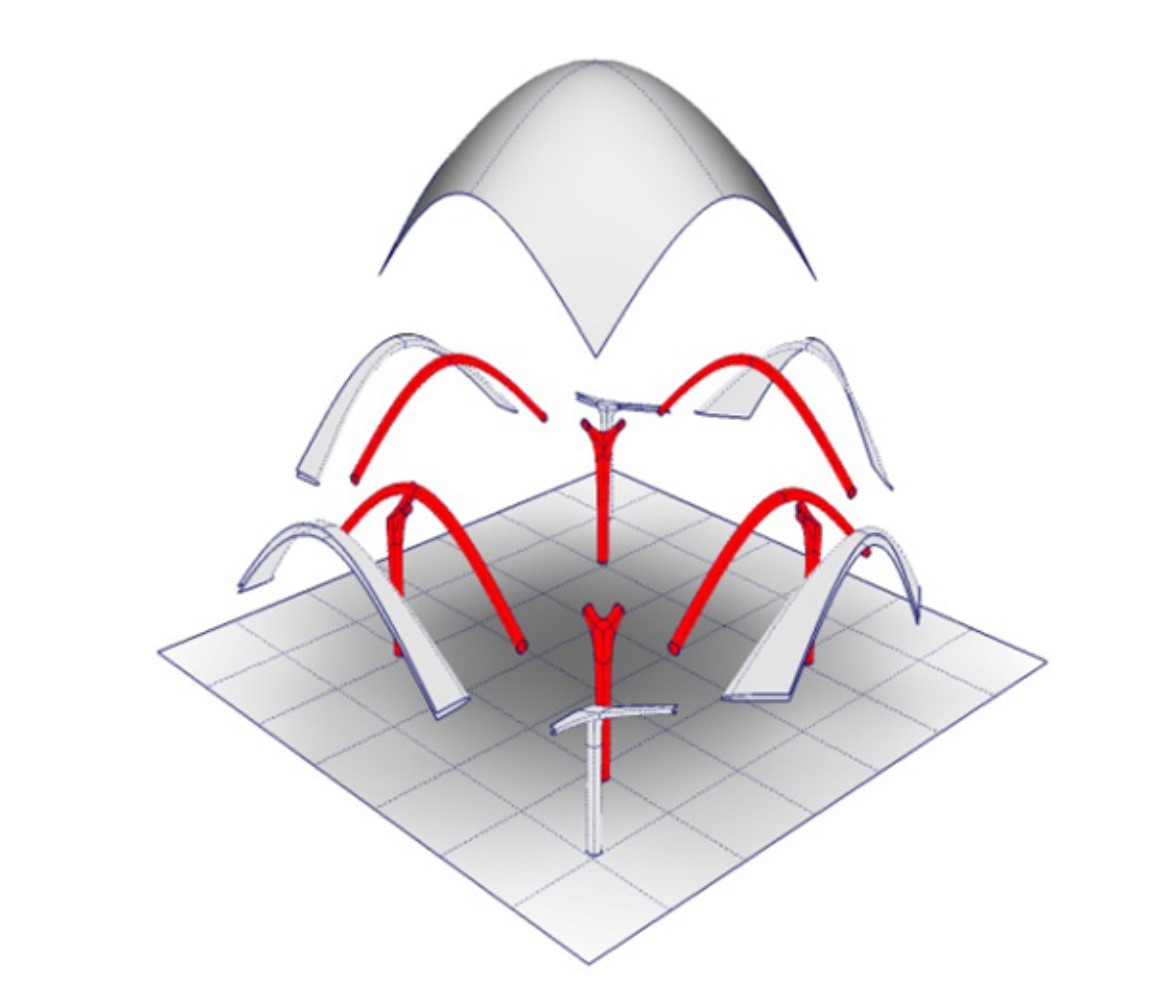
Growth in the role of simulation, in conceptual design and evaluation of building performance, is coupled with the need for architects to manage the dichotomy between high resolution geometries used in simulation and lower resolution, free-form manipulation-friendly geometries. We argue for the benefits of Hierarchical Subdivision-surfaces (HSS) in this process, concentrating specifically on its uses in several areas. First, we discuss HSS for the design and approximate simulation of Shell structures using particlespring methods and its correlation with FEA analysis. Second, we show the benefits of HSS for the procedural modeling of large numbers of such shells. Third, the preengineering rationalisation of such designs is explained and, lastly, the preparation of such geometries for downstream production, including fabrication and construction, is discussed. The paper will present case studies for each area, the design of architectural competition entries within the areas, and mock-ups of structures designed and fabricated using these methods.
Citation
Bhooshan, S. and El Sayed, M., 2011, April. Use of sub-division surfaces in architectural form-finding and procedural modelling. In Proceedings of the 2011 symposium on simulation for architecture and urban design (pp. 60-67).